
THE Royal Liver Building is an architectural masterpiece, which some people doubted could ever be built.
The building was commissioned by finance firm the Royal Liver Friendly Society, who at the time had more than 6000 employees and needed a new head office. Designed by Walter Aubrey Thomas, the foundation stone for the building was laid on 11 May 1908, and on 19 July 1911 the building was officially opened by Lord Sheffield.
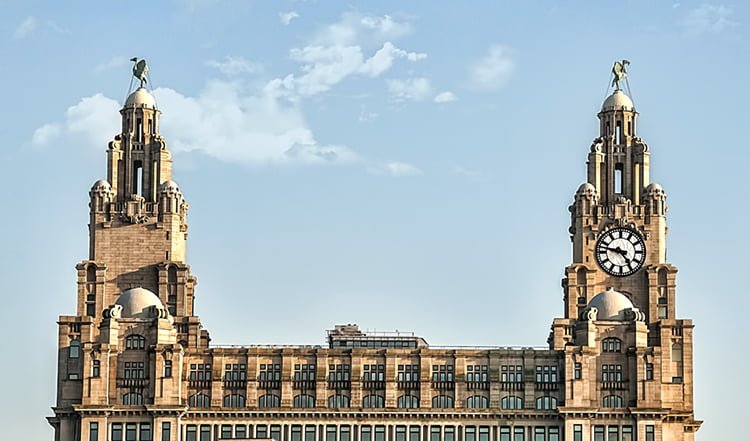
The impressive clock faces are actually larger than the clock face of Big Ben in London. In fact, they are largest clock dials in Britain. In 1953 electronic chimes were installed to serve as a memorial to the members of the Royal Liver who died during the two World Wars. At night time the clock dials are illuminated. They were originally called George clocks, because they were started at 1.40pm, the precise time that King George V was crowned on 22 June 1911.
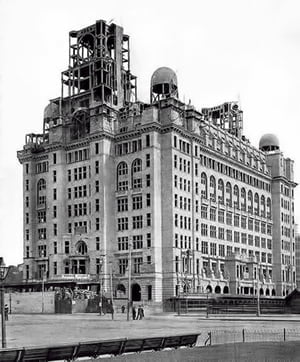
The building became the first major structure in Britain, and one of the first buildings in the world to be constructed using reinforced concrete, and given the building’s radical design was considered by some to be doomed.
It is notable as one of Britain’s first multi-story reinforced concrete framed buildings. Stylistically unique in England, it is more akin to the early tall buildings of America such as the Allegheny Court House (1884) by H.H. Richardson and the Garrick (formerly Schiller) Theatre by Adler and Sullivan. It has nine bays on each front and thirteen bays on the sides. The top floor steps back behind a Doric colonnade, taking advantage of the technical possibilities offered by its reinforced concrete structure. The roof has turrets and domes in receding stages and the clock towers have copper Liver Birds designed by Carl Bernard Bartels and constructed by Bromsgrove Guild.
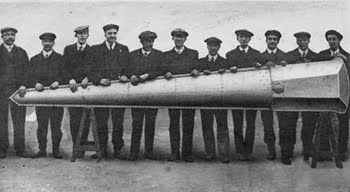
The Bromsgrove Guild were awarded this important commission by The Royal Liver Assurance Company who wanted two mythical Liver Birds to be mounted on the twin towers of its new head office at the Pier Head when it opened in 19 July, 1911.
Their construction presented many problems, firstly their size and the fact that they were to mounted 300 feet from the ground. This meant that they would have to be constructed to withstand high winds but not be too heavy.
The birds are based on Liverpool’s official mascot the Cormorant (seaweed bird) which in bygone times could often be seen flying alongside the Mersey River with seaweed in their beaks.
They were constructed in Bromsgrove, dismantled and then transported to Liverpool. The statues were then reassembled from the collection of small pieces of copper sheeting. Standing 18 feet tall they have a total wing span of 24 feet.
It was decided that once installed they would be gilded and scaffolding and screening was erected to protect the men working at this great height. One worker later said that twice as much gold leaf blew away as was actually applied to the birds!
The two birds face away from each other, one towards the river and the other towards the city. The eposes are traditional; the birds stand with half-upraised wings, each carrying a sprig of seaweed in its beak.
The birds are 18 ft high, their heads are 3½ ft long, the spread of the wings is 12 ft, their length is 10 ft and the legs are 2 ft in circumference. Their bodies and wings are of moulded and hammered copper fixed on a steel armature.
Local legend has it that they are a male and female pair, the female looking out to sea, watching for the seamen to return safely home, while the male looks towards the city, to see if the pubs are open.